Saying "Yes" Strategically

With the ever-increasing demands on our time, discernment is the first line of defense for protecting our well-being. Even activities or projects that would typically energize us can feel overwhelming when our plates are overfull. Saying “yes” strategically can help us leave room to be supportive, productive contributors and fully engage in the activities and projects that fill our proverbial cups without guilt or trepidation. This resource and quick reference infographic will first walk you through steps to evaluate requests for your time, and then provide strategies for saying “no” to certain opportunities in order to fully engage and say “yes” to others.
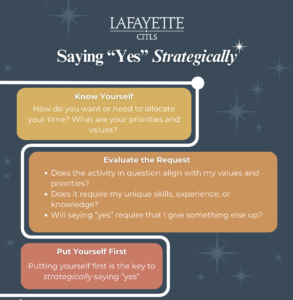
Know Yourself
 Before considering a request for your time, it’s important to reflect on your own priorities, values, and capacity. Assess your current responsibilities and threshold for more. How do you want or need to allocate your time? What are your priorities and values?
Evaluate the Request
If you’re unsure whether a request makes sense for you, ask yourself the questions listed below. If saying “yes” doesn’t meet some or all of the criteria, it may be a sign to decline the request.
- Does the activity in question align with my values and priorities?
- Does it help me move closer to a personal or professional goal?
- Does it require my unique skills, experience, or knowledge? (Could someone else do it just as well, or better, than I can?)
- Will saying “yes” allow me to continue to participate in the other activities to which I am committed?
- Does saying “yes” align with my purpose?
- Will saying “yes” help me to feel fulfilled?
- Will saying ”yes” require that I give something else up? If so, what would that be, and how would I go about doing that?
Put Yourself First
Putting yourself first – or at least not always last – is key to the art of strategically saying “yes.”
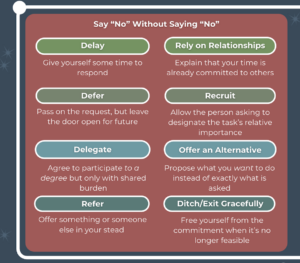
Say “No”
 Sometimes, as much as we may want to say “yes,” we simply can’t take on an additional task. There are a lot of different ways to go about saying “no,” and the following strategies can help you decline requests for your time in ways that maintain or even strengthen relationships with colleagues, while also prioritizing your own well-being.
Delay
Give yourself some time to respond
- “I’ll have to think about that and get back to you; I can’t answer that now.”
Defer
Pass on the request now, but leave the door open for later opportunities or collaboration
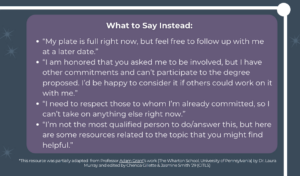
- “My plate is full right now, but feel free to follow up with me at a later date.” o “I am interested in this, but I can’t take it on right now. Can we revisit this topic in the future?”
- “Our time to work together isn’t here…yet.”
Delegate
Here you agree to participate to a degree, but only if you can share the burden/responsibility
- “I am honored that you asked me to be involved, but I have other commitments that make it impossible for me to participate to the degree that you propose. If other people could work on this with me, and we’re clear about everyone’s roles, I’d be happy to consider it….”
Refer
Offer something in your stead. This approach allows you to avoid saying “no” outright while also protecting your time and letting the requestor feel heard and valued.
- “I’m not the most qualified person to do/answer this, but here are some resources related to the topic that you might find helpful.”
- “Perhaps you might talk to X about working on that…”
Rely on Relationships
Here you offer the relational reasons for why you can’t agree to the request. You’re relying on basic human decency and compassion, while also offering a reason (relationships) that will allow you to preserve your image as a generous, caring, and responsible person. The benefit of this approach is that it mitigates the risk of appearing cold and uncaring when you say ‘no.’”
- “I need to respect those to whom I’m already committed, so I can’t take on anything else right now.”
- “If I helped you, I’d be letting others down.”
Recruit
Here you recruit the person asking something of you to help you problem-solve and manage multiple responsibilities. This strategy allows you to say “no” without actually saying “no” and can be especially useful when responding to a supervisor or someone in a position of authority.
- Instead of “I have absolutely no time for that!” try “Could you help me prioritize my projects?” This gives you the opportunity to clearly communicate what you’re working on, how long it’s taking, and what you would have to delay or set aside in order to take on the new task.
- A benefit of this approach is that you give the requestor an opportunity to say what they think is most important. If the new, proposed, project can be put off for a later date, it will be. And if it needs your attention right away, you have the go-ahead to set something else aside to work on it.
Offer an Alternative
Here you propose what you want to do, as opposed to exactly what is asked of you.
- “I don’t think I’m the right person for that, but I’d be happy to help in this way instead…”
Ditch (aka “Exit Gracefully”)
This strategy allows you to extricate yourself from a current commitment when it is no longer fulfilling or you realize that it is taking up more time than you would like. The key here is to remember that you need to say “no” in order to “yes” to other opportunities or priorities.
- “I really appreciate that you’ve given me the opportunity to work on/do this project/activity with you, but right now I need to turn my attention to other priorities.”
- Sample script for an email: “Thank you so much for thinking of me. I was incredibly flattered that you asked me to [insert what they asked you to do]. I try to be very deliberate about where I put my time, energy, and attention, and only say ‘yes’ to opportunities that align with my strengths and long-term goals. Unfortunately, sometimes I say yes without considering the big picture, which, to my embarrassment, is what happened here. Although I would love to be able to continue [insert thing you have been doing here], I must respectfully change my ‘yes’ to a ‘no’. I’m finding myself overextended with other commitments and don’t see a way to make everything happen to the standards I hold myself to.”
Conclusion
Saying “yes” strategically is a skill. And like any other skill, it takes time to learn and hone. Sharpening your abilities by thinking through these practice scenarios can help you on this journey. So practice often, choose wisely, and make every “yes” count!
*This resource was partially adapted from Professor Adam Grant’s work (The Wharton School, University of Pennsylvania) by Dr. Laura Murray and edited by Chenoa Gillette (CITLS).
Saying “Yes” Strategically Infographic -Downloadable Version