Meet Students Where They're at: Engagement In and Out of the Classroom
by CITLS Student Fellow, Skyler Chouloute '28

Student engagement is more than simply speaking in class. It can also be characterized by students interacting with content beyond a surface level, drawing “students into intense thinking activities like analyzing and understanding concepts, rationalizing procedures, and deducing meaning. It involves social interaction with peers and the teacher, in the form of exchanging experiences, knowledge, opinions, and support” (Amerstorfer & Freiin von Münster-Kistner, 2021). This definition is contextualized in a classroom setting, but “student engagement” is not a phrase reserved for purely academic settings. Student engagement outside of the classroom can be measured through participation in campus activities such as clubs, athletics, student government, and student research. Using these measures of engagement, I conclude that student engagement at Lafayette college is on a decline, and the diversification of classroom and extracurricular promotional materials, especially through an increase in short-form content, is a viable response.
As a mechanical engineering major, I have taken many classes with an assigned Mentored Study Group (MSG). In every class, I have been confronted with the same issue: students do not attend MSG sessions. I have been the only person in the MSG room ahead of an exam on multiple occasions. For my Dynamics class last year, my MSG’s attendance records indicated that, over the span of an entire semester, only 4 out of 34 students, including myself, had attended a session. Calculus Cavalry offered free, drop-in math tutoring and homework help for at least four years before the program was discontinued in the fall of 2025. There is no official statement from the Math Department or the Academic Resource Hub on the official reason for the cessation of the program. However, chatter among students points to the issue of low attendance. In the example of student government- as of September of this year, there were three senate vacancies and a vice president vacancy outside the timeline of the normal election cycle (The Lafayette, 2026). The lack of attendance and participation in these services display the issue of low student engagement here at Lafayette, and this issue should not be met with nonaction.
The success of short-form content in reaching students is evident through promotion for clubs and organizations on-campus. As the President of the Association of Black Collegians (ABC), I do a wealth of outreach and promotion around the times of our events. I constantly ask other students “Do you know about this event, and are you going?” By far, through my own outreach, I have found time and time again that people will be more likely to receive information from a tiktok/modern meme than a flyer, email, or other traditional form of disseminating information. Promotions for the Association of Black Collegians that are framed around short form content are far more successful than other kinds of promotion within the first 48 hours. Using views as a concrete measure of engagement, consider the baby-shower themed event that the Association of Black Collegians hosted during March of 2026.
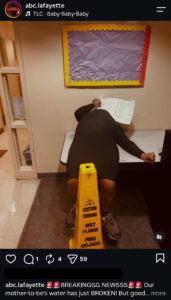
ABC Lafayette Instagram Post, promoting the baby shower themed event for Women’s History Month
The event was announced five days before it was scheduled to take place, which is a record turnaround for ABC events; our rule of thumb is a minimum of seven days, but ideally 10 to 14. Regardless, the nature of our promotion got students talking, and garnered a shocking 12,991 views across promotional posts, compared to our norm of approximately 3,000. Within the initial 5-days, the posts had reached 10,000 views, and my in-person outreach made it evident that students had not only seen the posts, but could tell me the date, time, and location of the event, which is far from the norm. The event itself saw increased engagement from upperclassmen in particular. In fact, in October of 2026, seven months after the baby shower event, I sat on a student panel to present about affinity spaces to prospective Lafayette students. High school students asked how they might know about events, and before I could answer, another Lafayette student, who was abroad during the baby shower event in March, said to “show them the ABC baby shower.” Students are not only viewing information from the short-form content that we release, but internalizing and remembering it.
California’s first fully-online community college, Calbright College, integrates short form video learning into curricula, and reports increases in student engagement in areas where short form content was implemented. Ideas42, Calbright College, and UC Irvine collaborated to develop a variety of 60-second vertical-format videos, much like those on Tiktok or Instagram Reels, to provide instruction to students on topics such as how to meet with their counselors, how to use the school’s career services, and how to enroll in classes. Ideas42 reports a 16% increase in students who received video instruction completing their first assignment, a 40% increase in likelihood to meet with a counselor after receipt of a short video, and a 70% increase in downloads of material that had a short, promotional video to go with it (Ideas42). With student organizations at Lafayette driving engagement through short-form content and a college across the nation driving academic engagement in the same way, professors and faculty at Lafayette should consider these successes in developing a response to our own engagement problem.
Student engagement is down, not because students do not care anymore, but because information is not reaching them how it used to. Students cannot attend events or engage in learning that they are unaware of, so it is critical to tackle the first step of reaching students and promoting engagement with information beyond a surface level. During an era of information overload where, on average, students are receiving more than 240 phone notifications per day (University of Michigan Health, 2023), it is critical to engage students in ways that they are becoming accustomed to. Short-form content is sweeping the internet, and instead of organizing classrooms and college spaces to be in opposition to this new wave, I believe it is far more productive to integrate this new style of disseminating information where we can. Student organizations at Lafayette are starting to implement short-form content to standard practices, and I encourage Lafayette faculty to do the same. Following the model set forth by Calbright College, UC Irvine, and Ideas42, short-form content videos have a place in the classroom setting as instructional videos, content explanations, and more. Implementing this new style can be daunting, but I encourage academic departments and other services and programs across campus to work with students to join this wave even if that first step is hiring a student worker for information promotion.
References:
Amerstorfer, C. M., & Freiin von Münster-Kistner, C. (2021). Student Perceptions of Academic Engagement and Student-Teacher Relationships in Problem-Based Learning. Frontiers in psychology, 12, 713057. https://doi.org/10.3389/fpsyg.2021.713057
Ideas42. Short-form mobile videos to drive student engagement. https://www.pse.ideas42.org/calbright-impact-hub/driving-engagement-mobile-video
The Lafayette. (2026, September). Student Government VP resigns, special election to be held in 2 weeks. https://lafayettestudentnews.com/192033/news/draft-stugov-vacancy/
University of Michigan Health & Common Sense Media (2023, September 6). Constant Companion: A week in the Life of a Young Person’s Smartphone Use. https://www.michiganmedicine.org/health-lab/study-average-teen-received-more-200-app-notifications-day